
The Centre for Public Integrity, a US-based non-profit investigative news organisation, has published a report which says that South Africa has enough nuclear explosives to fuel half-a-dozen bombs.
According to the report, the nuclear explosives are locked in a former silver vault at the Pelindaba Nuclear Research Centre close to the Hartbeespoort Dam.
Pelindaba is operated by The South African Nuclear Energy Corporation, and was were South Africa’s atomic weapons under apartheid were developed, built, and stored.
These explosives were created by the apartheid government as part of its nuclear weapons programme. According to a report by Marcus Duvenhage, South Africa had six nuclear devices, and was busy constructing a seventh, by the time the programme stopped.
South Africa ended its nuclear weapons programme in 1989, and these weapons were dismantled.
However, the highly-enriched uranium fuel was extracted, melted down, and cast into ingots.
The report states that roughly 220kg of this fuel remains, and that South Africa is “keeping a tight grip on it”.
This weapons-grade nuclear fuel means South Africa can easily become a nuclear state again. However, the biggest concern to the United States is that it will be stolen by militants and used in a terrorist attack.
According to U.S. officials and experts, South Africa’s nuclear explosives are among the most vulnerable in the world to theft by terrorists.
U.S. officials further argue that South Africa has no clear rationale for holding its nuclear explosive materials, because it no longer needs them to make medical isotopes.
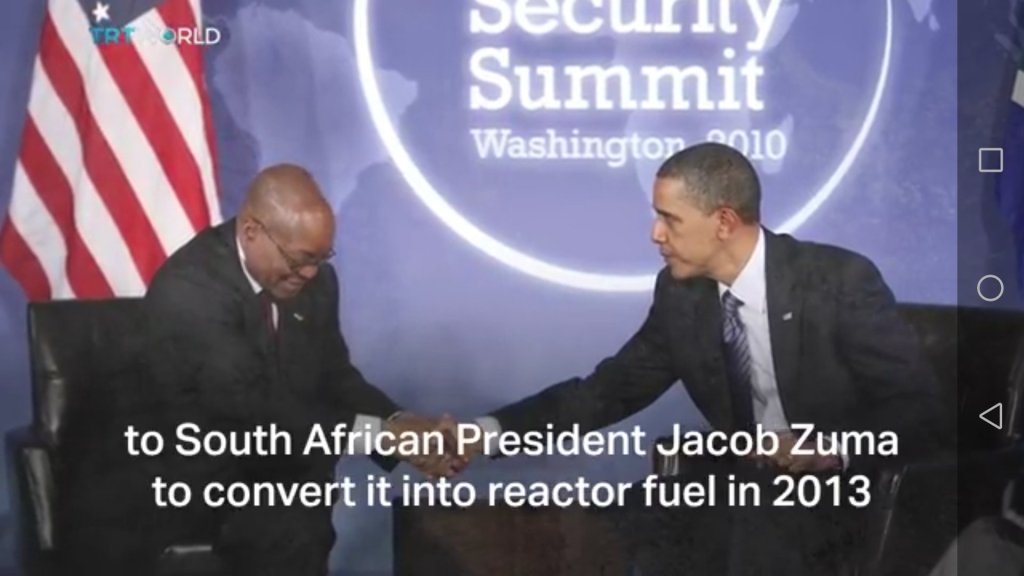
The Centre for Public Integrity said that US President Barack Obama twice directly asked the South African president to relinquish this weapons-grade uranium. However, the SA president did not oblige.
The full report is available here: South Africa rebuffs repeated U.S. demands that it relinquish its nuclear explosives
Dismantling of SA’s atomic bombs
In a 2012 interview former SA president FW De Klerk said that soon after the fall of the Berlin Wall they decided to announce the dismantling of South Africa’s atomic bombs.
“We announced as soon as possible that we had broken those [nuclear] bombs down, [and] that we could account for every milli-milli-milli-milligram of material,” said de Klerk.
He added that they “would open all facilities to full inspection by the International Atomic Agency, and that is exactly what we did.”
Facts about South Africa’s nuclear weapons programme
While details about South Africa’s nuclear programme remains sketchy, there are some facts which are interesting.
Most of these are quoted from the Wikipedia article “South Africa and weapons of mass destruction”.
- South Africa’s plans to develop nuclear weapons began in 1948 after giving commission to the South African Atomic Energy Corporation (SAAEC).
- South Africa gained sufficient experience with the nuclear technology to capitalise on the promotion of the U.S. government’s Peaceful Nuclear Explosions (PNE) programme.
- In 1971, South African minister of mines Carl de Wet gave approval of the country’s PNE programme. The date when the South African PNE programme transformed into a weapons programme is not known.
- The South African Atomic Energy Board (AEB) selected a test site in the Kalahari Desert. Two test shafts were completed in 1976 and 1977. However, when the test site was exposed by Soviet and Western governments, its immediate shutdown was ordered.
- In September 1979, a US satellite detected a double flash over the Indian Ocean that was suspected, but never confirmed, to be a nuclear test. In 1997, South African Deputy Foreign Minister Aziz Pahad stated that South Africa had conducted a test, but later retracted his statement.
- The South African Defence Force (SADF) investigated aircraft and missile-based delivery systems. The missiles were to be based on the RSA-3 and RSA-4 launchers that had already been built and tested for the South African space programme.
- South Africa ended its nuclear weapons programme in 1989. All the bombs – six constructed and one under construction – were dismantled.
- On 19 August 1994, after completing its inspection, the International Atomic Energy Agency (IAEA) confirmed that one partially completed and six fully completed nuclear weapons had been dismantled.

